





ESOP Tax Guides

Simplify ESOP taxation for employees. Stay fully compliant as an employer​

From grant to exercise to sale, every ESOP milestone triggers tax implications. Qapita helps companies streamline ESOP tax management by educating employees, enabling accurate finance execution, and ensuring end-to-end compliance across all equity tax events.​
blue bg
G2 Grid® for Equity Management Software | Summer 2025

Recognized as a Global Leader on G2

We are ranked the best in Customer Satisfaction, Enterprise and Mid-Market.

Why companies choose Qapita for ESOP taxation clarity and compliance​

Purpose-built to handle ESOP tax complexity in India​

ESOP taxation in India spans perquisite taxation at exercise, capital gains at sale, and employer obligations around TDS and reporting. Qapita is built specifically for this complexity and helps companies interpret tax implications correctly across every ESOP event, rather than relying on fragmented advice or manual calculations that increase risk.​

Brings tax logic, valuation data, and execution together​

ESOP tax outcomes depend on accurate fair market value, exercise timing, and holding periods. Qapita connects tax guidance with underlying ESOP and valuation data, so finance teams can determine tax impact with confidence, support payroll execution, and avoid inconsistencies across systems or spreadsheets.​

Reduces employee confusion and downstream compliance risk​

Unclear ESOP tax treatment often leads to employee dissatisfaction and last-minute escalations for HR and finance teams. Qapita helps companies proactively explain tax outcomes, prepare employees for liabilities, and maintain clean records for audits and regulatory review, reducing both operational friction and compliance exposure.​

How Qapita manages ESOP taxation for Indian companies​

India-Specific Tax Guidance for All Instruments

One platform. All tax scenarios. Fully explained.​

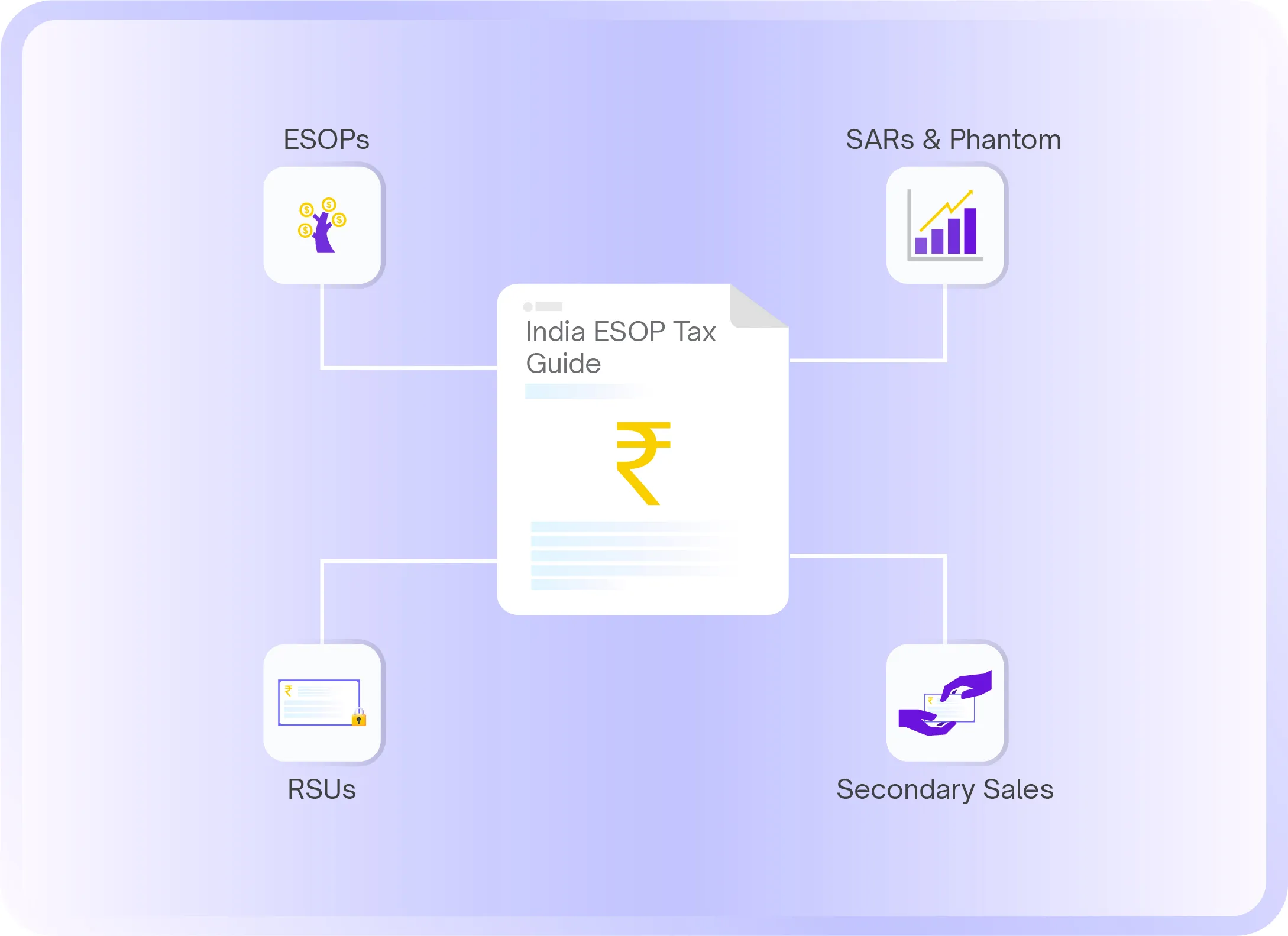
We provide structured tax guides covering:​

• ESOPs (perquisite taxation)​
• SARs and Phantom Shares (cash-settled income)​
• RSUs and Restricted Stock​
• Secondary Sales and Buybacks (capital gains implications)​

Each guide is customized to your company’s equity structure and payout model, ensuring relevant, scenario-based clarity.​
Tax Lifecycle Education for Employees

Tax doesn’t have to be a mystery​

Qapita supports employee communication with step-by-step tax explainers:​

• What happens at grant, vesting, and exercise?​
• What is the tax rate?​
• How does perquisite tax calculated with FMV, exercise price?​
• When is capital gains tax applicable?​

​We offer in-platform guidance, FAQs, and optional education sessions led by tax professionals.​
TDS and Perquisite Tax Handling

Meet every filing and disclosure obligation with ease​

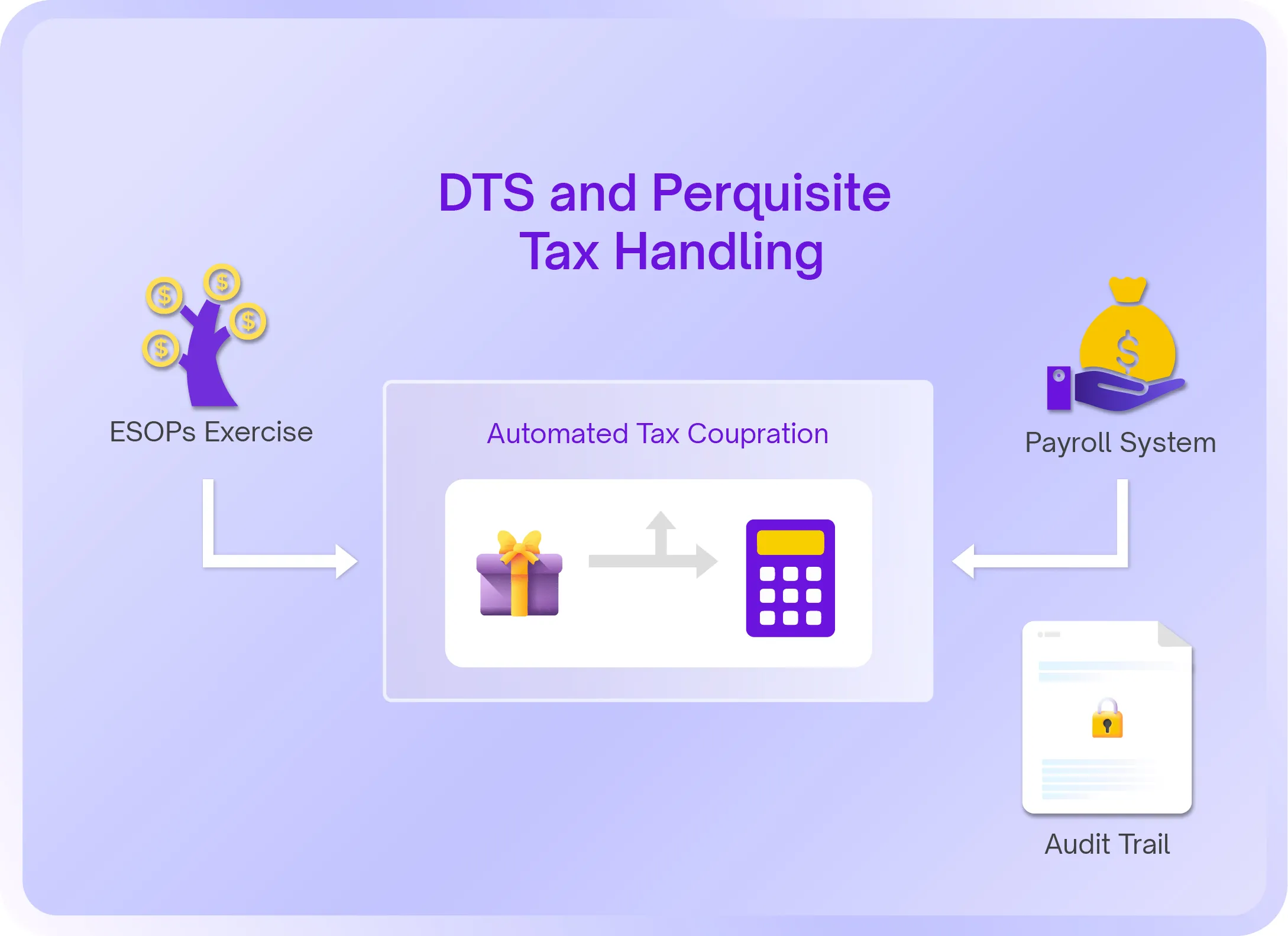
We help you compute perquisite tax on ESOP exercises and withhold TDS under Section 192 for company funded tax activities. Qapita generates per-user calculations, integrates with payroll - with full audit trails.​
Global Tax Scenarios (Inbound & Outbound Employees)

Cross-border equity, explained simply​

We support equity education across the lifecycle - fromfounder or HR-level workshops to employee tax guides in 160+ countries. We help explain grant mechanics, tax impacts, and long-term value in ways that build trust and alignment – not confusion.​
Company-Funded Exercise Support

Support for company-sponsored ESOP transactions​

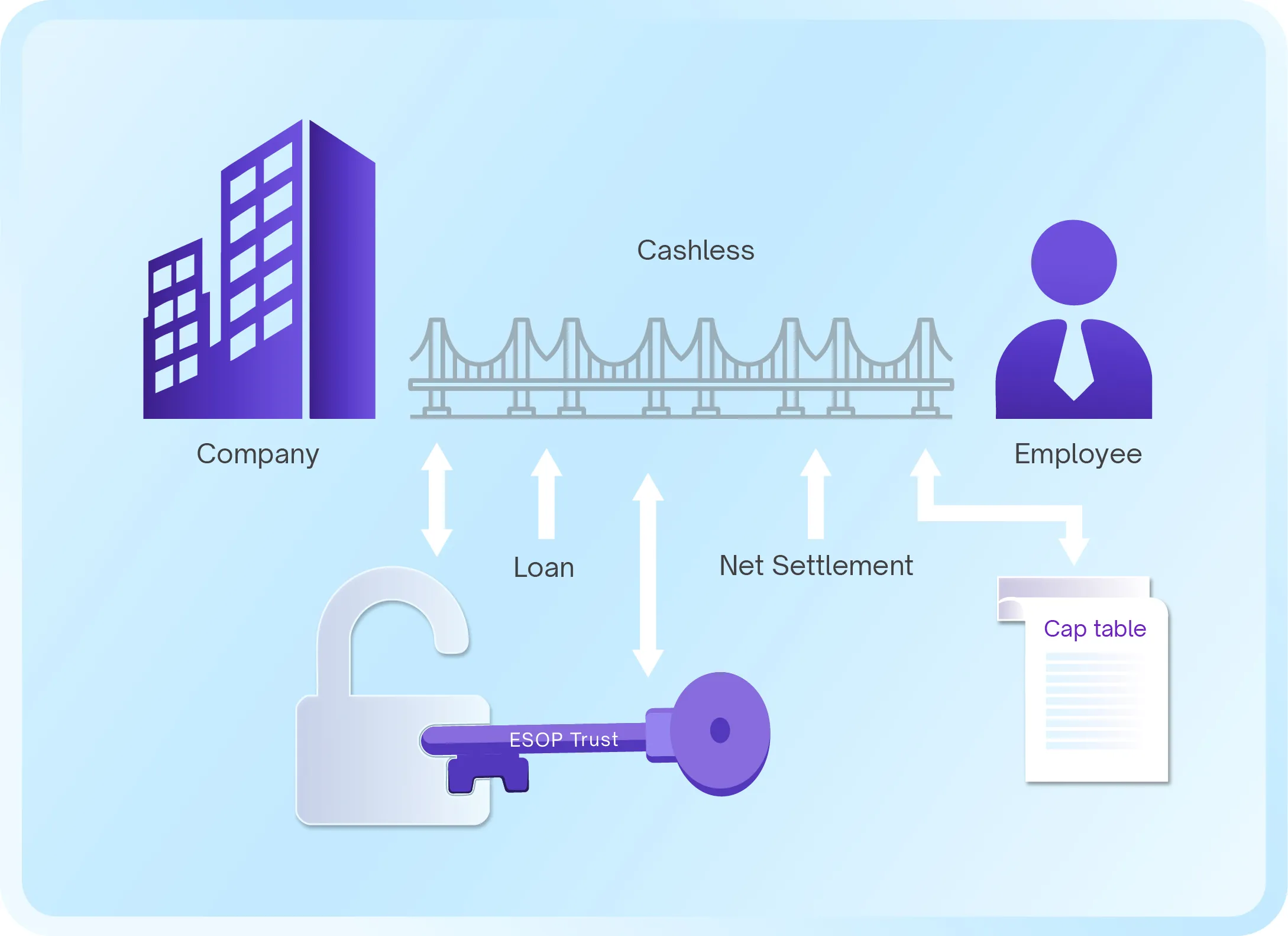
If your company funds ESOP exercises either as a bridge before a liquidity event or to reduce employee tax burdens, Qapita helps structure and facilitate the transaction. We support cashless exercises, loan-led, net-settlement, or reimbursement mechanisms, with documentation, tracking, and cap table integration, ensuring clarity for employees and full control for the company.​
Testimonials

Words from our valued customers

They have extensive knowledge in this space. ESOP Direct guided us step by step through the entire process. We are particularly happy with their alacrity in responding to our queries!
Edward Tirtanata
CEO & Co-Founder, Kopi Kenangan
We are glad to have found a very competent consultant in ESOP Direct. A worthy partner to work with, is what I’d say.
Manhar Kapoor,
General Counsel & Company Secretary, Eicher Motors
ESOP Direct acted as Trustees for our employee stock option scheme. I am fully convinced we have made the right choice.
Umasree Parvathy
Chief Peoples Officer, Northern Arc
They worked alongside with us during the process great example of collaborative efforts to customize an employee stock option plan from scratch.
Yeoh Chen Chow
Co-Founder, MyFave
Their meticulous study and report gave us relevant data to take an informed decision. We are glad we engaged ESOP Direct.
Shailesh Singh
Head HR, Max Life Insurance
We entrusted our complete Plan administration function to ESOP Direct.I wish ESOP Direct greater success in the coming years.
Mona Cherian
President and Group Head HR, Thomas Cook
Qapita Works With Companies Across the Globe From Seed Stage to Listing and Beyond

Simplify ESOP Taxation From Grant to Sale

Educate your employees and ensure full compliance for your company across all tax events.
Testimonial

Lorem ipsum dolor sit amet consectetur

Lorem ipsum dolor sit amet consectetur, Lorem ipsum dolor sit amet consectetur, Lorem ipsum dolor sit amet consectetur
Metrics

Helping you elevate your equity management

Value of Options Under Administration
$10bn+
Assignments
1400+
Cumulative Years of Track Record
22+
Countries Served
60+
Global Employees Served
300,000+
Other Offerings

Your roadmap to broader equity solutions

Employee Liquidity Programs

Enable structured liquidity events through buybacks and surrender programs, empowering employees without waiting for an IPO.

Employee Exercise Program

Make exercising options easy for employees and finance teams with a seamless, fully digital, compliant experience.

ESOP Instruments Feasibility Study

Choose the right equity instrument for your stage, strategy, and stakeholders by evaluating legal, tax, and control implications.
Integrations

Our Integrations

Lorem ipsum dolor sit amet consectetur. At ullamcorper luctus facilisi gravida turpis vel morbi mollis. Pharetra molestie at sed vulputate.
FAQs

Frequently asked questions

What is ESOP taxation in India and when is it triggered?​

In India, ESOPs are typically taxed at two stages: ​

  • As a perquisite at the time of exercise when the difference between fair market value ​
  • Exercise price is considered income, and as capital gains when the shares are sold based on holding period.

How is perquisite tax on ESOPs calculated?

Perquisite tax is computed on the difference between the fair market value (FMV) at exercise and the exercise price. This amount is added to the employee’s salary and taxed at applicable slab rates, with TDS obligations for employers​

How does ESOP tax differ for NRIs?​

NRIs may be taxed in India on perquisites at exercise and capital gains at sale. Their residential status and any applicable DTAA treaties influence how and where tax applies​

Will I owe tax just for being granted ESOPs?​

No. Generally, grant is not a taxable event in India; tax is triggered at exercise/perquisite and later at sale.​

What happens if I don’t exercise my ESOPs before leaving?​

Unvested ESOPs typically lapse; vested ESOPs may have a limited exercise window post-exit per company policy, and tax implications depend on exercise timing. (Check your ESOP plan details with HR)​

How does Qapita help companies calculate ESOP tax liability automatically?​

Qapita integrates FMV data, vesting schedules, and exercise history to generate accurate perquisite tax calculations and estimate future capital gains, reducing manual errors and improving payroll accuracy.

Does Qapita handle TDS calculation and withholding simulation for ESOP tax?​

Qapita supports TDS estimation on perquisite value for payroll integration, helping finance teams
anticipate withholding amounts and avoid miscalculations.​

How can Qapita help HR educate employees about ESOP tax outcomes?​

Qapita enables employee-friendly tax reports and dashboards that explain tax liabilities, timelines, and implications in simple terms, reducing HR queries and confusion.​
ESOP Tax Guide 101

ESOP taxation in India​

Employee Stock Option Plans (ESOPs) are widely used by Indian companies to reward long-term contributions and align employees with business growth. However, while ESOPs are often discussed in terms of ownership and upside, their tax implications are complex and frequently misunderstood.

ESOP taxation in India is not a single event. It unfolds across the equity lifecycle, with different tax treatments, valuation requirements, and compliance obligations at each stage. For employees, this can create unexpected tax liabilities. For employers, it introduces operational risk, reporting obligations, and the need for consistent tax treatment.

Understanding ESOP taxation is essential for both employees and companies to avoid friction, ensure compliance, and preserve the intended value of equity compensation.

How ESOP taxation actually works across the lifecycle

One of the most common misconceptions around ESOPs is that tax applies at the time of grant or vesting. In practice, ESOP taxation in India is triggered primarily at two points:​

  • At exercise, when the difference between the fair market value (FMV) of the shares and the exercise price is treated as a perquisite and taxed as salary income.​
  • At sale, when the difference between the sale price and the FMV at exercise is taxed as capital gains, depending on the holding period and whether the shares are listed or unlisted.​

Each of these stages follows different tax logic, rates, and reporting rules. This makes ESOP taxation fundamentally different from regular salary income and more sensitive to timing, valuation accuracy, and execution.​

Why clear ESOP tax guidance matters for employers and employees​​

ESOPs are designed to build ownership culture not tax confusion. Yet, mismanaged ESOP taxstrategies can erode trust, create financial stress, and burden HR and finance teams.​​

Here’s why structured ESOP tax guidance is essential:​​

For employees

  • Understand when tax applies and how much they may owe​
  • Plan exercises around liquidity and cash flow​
  • Avoid surprises during tax filings​
  • Assess the real value of equity compensation​

For employers​

  • Ensure accurate TDS deduction and reporting
  • Avoid compliance errors that may trigger audits or penalties​
  • Transparent communication during onboarding​
  • Enhance employee experience through proactive education

Why ESOP taxation becomes complex

ESOP taxation as a cash-flow and timing challenge​

One of the most overlooked aspects of ESOP taxation is its impact on cash flow, particularly for employees of private companies. Exercising ESOPs can trigger immediate tax liability even when the shares cannot be sold and no liquidity is available.​

This disconnect between tax obligation and liquidity often forces employees to delay exercise, miss favorable valuation windows, or forgo their options altogether. In many cases, ESOP taxation becomes a financial risk rather than a reward.​

Why ESOP taxation is often confusing for employees​

For many employees, ESOPs are their first exposure to equity compensation. Concepts such as perquisite taxation, FMV, holding periods, and capital gains are unfamiliar and rarely explained in a structured way. ​

Online information around ESOP taxation in India is often fragmented or generic, leading to confusion about when tax applies, how much tax is payable, and what happens if shares are never sold.​

Employer challenges in ESOP tax compliance​

While ESOP tax liability ultimately rests with employees, employers play a central role in ensuring accurate execution and compliance. Companies are responsible for calculating the perquisite value at exercise, deducting and depositing TDS within prescribed timelines, maintaining defensible valuation records, ensuring payroll alignment, and supporting audit, statutory, and regulatory reporting requirements.

As ESOP programs scale across larger employee bases and multiple grant cycles, manual tax calculations and fragmented processes significantly increase the risk of payroll errors, reporting inconsistencies, compliance gaps, and employee disputes around tax deductions, valuation methodology, and equity value realization.

How ESOP taxation evolves as companies grow​

ESOP taxation dynamics change significantly as companies move from early-stage startups to growth-stage businesses and eventually to listed entities. FMV appreciation, liquidity availability, and employee expectations evolve at each stage.

​​Additionally, certain eligible startups may offer deferred tax benefits that alter the timing of ESOP tax liability. Without clear guidance, these variations can lead to inconsistent decision-making and compliance challenges.

​​Understanding how ESOP taxation interacts with company maturity helps both employees and employers plan equity participation more effectively.​

Ensure Seamless ESOP Tax Compliance for Your Company

Simplify finance team execution and ensure full regulatory adherence across all tax events.