


 Equity management

 Equity management
- Fund management

 Fund management
 - Fund managementFund management
- Fund managementFund management
Growth shares are a class of shares created for employees or senior hires, giving them a right to a share of the company's value only above a set "hurdle" price. The hurdle is usually set close to the company's current valuation, so growth shareholders benefit only from value the company creates after they join. Founders and investors hold ordinary shares, which carry the full value of the company, while growth shares sit below these and pay out only once the valuation crosses the hurdle.
Growth shares and ordinary shares serve different purposes in your startup's equity structure. Understanding these differences is crucial for making informed decisions about your compensation strategy.
Let's consider an example here. Suppose your startup is currently valued at $5 million. You issue growth shares to a key employee with a $7 million hurdle. If the company is later sold for $15 million, this employee will only benefit from the $8 million increase in value above the hurdle. If they held ordinary shares, their stake would be worth a portion of the full $15 million, but they might have faced a higher tax bill initially.
While both growth shares and stock options are equity incentives, they differ in several key aspects that can impact your startup's compensation strategy.

Growth shares are most effective when a company wants to reward key individuals for future performance without touching the value already built by founders or existing investors. Here are the scenarios where they make the most sense:
1. Attracting executive talent on a tight budget: Early-stage companies competing for senior talent rarely have the cash to match corporate salaries. Growth shares bridge this gap by offering executives a compelling stake in the company's future, one that becomes valuable only if they help deliver the growth, they were hired to create.
2. Keeping critical people for the long term: Growth shares can be structured with vesting schedules and leaver provisions that tie full ownership to continued tenure or the achievement of specific milestones. This makes them a powerful retention tool, ensuring key contributors remain invested, literally and figuratively, in the company's trajectory.
3. Building toward a future exit: For companies working toward an acquisition or IPO, growth shares ensure that the people responsible for getting the business there have a direct financial stake in the outcome. Management participation in exit value creates alignment between those running the business and those who own it.
4. Meeting investor expectations post-fundraise: External investors, particularly private equity and venture capital, often require management to have meaningful skin in the game after an investment round. Growth shares satisfy this expectation by giving management a share in future upside without eroding the value that existed at the time of investment.
When you decide to issue growth shares, you create a distinct class of equity within with specific rights tied to the future growth of your company. Here are the key steps involved in this process:
The hurdle price for your growth shares is a critical element that needs careful consideration. Typically, it is based on a professional valuation of your company at the time of issuance to determine the market value of the shares. You might use methods like market analysis of comparable companies, discounted cash flow projections, or seek a formal valuation from an independent firm.
The hurdle price plays a vital role in ensuring fairness to both existing shareholders and holders of new growth shares. It aligns expectations by clearly defining the point at which the incentive kicks in. Setting an appropriate hurdle is essential; if it is too high, it might demotivate employees, but if it is too low, it could dilute existing shareholders prematurely.
Vesting schedules for growth shares are designed to encourage long-term commitment from your team. A typical cliff vesting schedule might look like this:
For example, if you grant an employee 1,000 growth shares:
Vesting conditions often include continuous employment and can integrate specific performance milestones. These conditions help you retain essential talent and ensure recipients remain actively engaged and aligned with your startup's long-term strategic objectives.
Employees realize value from growth shares primarily when your company experiences a significant liquidity event, such as an IPO or an acquisition. Consider a scenario where your startup is acquired for $50 million, and the hurdle price for the growth shares was set at $20 million.
In this scenario, the value created above the hurdle is $30 million ($50 million - $20 million). The holders of the growth shares would then be entitled to their pro rata share of the $30 million, according to the percentage of the total growth shares they hold. If, however, the exit valuation remains below $20 million, these growth shares yield no payout, emphasizing performance-based rewards.
Growth shares offer compelling advantages for both startups and employees, creating a win-win scenario that fosters company growth and individual success.
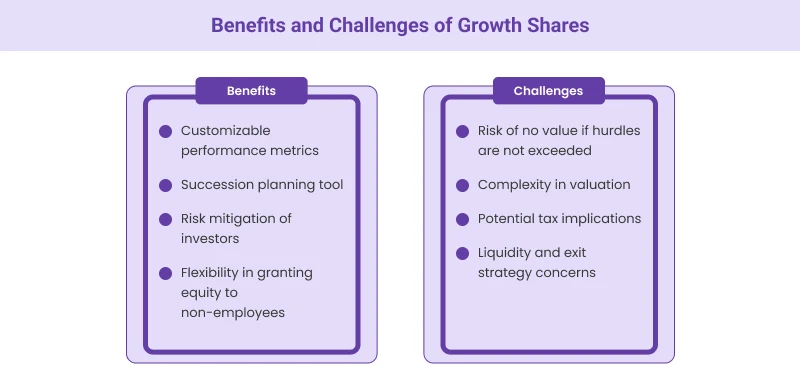
While growth shares offer numerous benefits, it is crucial to understand the potential drawbacks to make informed decisions for your startup.
Tax treatment depends on individual circumstances, so this is a general overview, not tax advice. A tax professional should review the specifics before a scheme is set up or shares are sold.
Employees generally owe no income tax when they acquire growth shares, provided they pay full fair market value at the time. Since the hurdle is set close to the company's current valuation, the fair market value of growth shares at grant is typically low, so the upfront cost to the employee stays manageable.
If shares are acquired below fair market value, the difference is treated as ordinary income and taxed through payroll withholding, reported on the employee's W-2 (the annual wage and tax statement employers issue). This becomes a "dry" tax charge, the employee owes tax on paper gains they can't yet sell shares to cover. A low initial valuation keeps this risk small, since the taxable spread stays small too.
Employees can also file a Section 83(b) election with the IRS within 30 days of grant, locking in tax treatment based on the share value at grant rather than at vesting. Missing the 30-day window removes this option entirely.
Capital gains tax applies to any increase in value when growth shares are sold. Shares held for more than one year from grant (or from the 83(b) election date) qualify for long-term capital gains treatment, which is generally more favorable than ordinary income tax. Shares sold within a year are taxed as short-term gains, at ordinary income rates instead. State tax may also apply on top of federal tax, depending on where the employee lives.
Some employees may also qualify for Qualified Small Business Stock (QSBS) treatment under Section 1202, which can exclude a portion of the gain from federal tax. This provision changed significantly under the One Big Beautiful Bill Act, signed into law in July 2025. For stock issued after that date, taxpayers can exclude up to 50% of gain on QSBS held for longer than three years, 75% for holdings longer than four years, and 100% for holdings longer than five years, with a shorter path to partial benefit than what applied before. Existing rules, including the full exclusion after five years and the lower gain cap, continue to apply to shares acquired on or before that date. Eligibility also depends on the company's structure and asset size at issuance, so this needs to be confirmed with a tax professional well before a sale, the rules are specific, the recent changes make timing matter more, and the benefit is significant when it applies.
Growth shares work alongside other equity plans, including stock options, and are commonly used by later-stage private companies looking to reward senior hires without the dilution a larger option grant would create.
Growth shares are ultimately a commitment mechanism; they work best when both the founder and the recipient genuinely believe in the company's trajectory. Setting the right hurdle, structuring shares correctly from the outset, and pairing them with transparent communication are what separate schemes that motivate from those that erode trust when expectations aren't met.
If you're considering implementing a growth share scheme, the decisions you make at the point of issuance, valuation, hurdle rate, vesting conditions, and legal structuring, will determine whether the scheme delivers its intended value. Getting those fundamentals right from day one is what makes the difference.
Growth shares offer a powerful mechanism to fuel your startup's journey by directly incentivizing your team based on achieving significant milestones. Their unique structure aligns the interests of your employees with your ambitious growth objectives. It helps develop a culture of ownership and rewards them for the value they help create above a predetermined threshold.
At Qapita, we provide a comprehensive equity management platform specifically designed to simplify the complexities of managing growth shares for startups. Our solution streamlines the entire process, from the initial grant and cap table management to tracking vesting schedules and modeling potential exit scenarios.
Our expertise in equity management, combined with our user-friendly platform, enables you to focus on growing your business while we handle the complexities of equity administration. Book a demo today and discover how we can support your startup's growth journey.
Growth shares are a flexible equity tool that can serve multiple commercial objectives. They are most commonly used as exit-based incentives, rewarding employees when the company's valuation exceeds the hurdle at a liquidity event. Beyond employee compensation, growth shares can also be issued to advisors, consultants, and key partners who contribute to company growth without being on the payroll. They can operate alongside other equity schemes, making them a versatile addition to any equity compensation strategy.
There are no fixed eligibility rules for growth shares, companies have full discretion over who receives them. In practice, they are most commonly issued to senior employees, executives, and directors whose roles directly influence company growth and valuation. Given the investment risk involved and the complexity of the structure, growth shares tend to be most suitable for individuals who have a clear understanding of equity and long-term value creation.
The hurdle rate is the minimum company valuation that must be exceeded before growth shares carry any financial value. It is typically set at a premium of 10–40% above the company's current market value at the time of issuance. This threshold ensures that existing shareholders retain the value they have already built, while growth shareholders only benefit from future appreciation above that point.
If the company's valuation at exit falls below the hurdle rate, growth shares yield no financial return. They effectively lapse without value since the threshold for participation has not been met. This is an inherent risk of the scheme and underscores the importance of setting a realistic hurdle rate at the outset, one that is ambitious enough to protect existing shareholders but achievable enough to remain a credible incentive for recipients.